Leisure World by the Numbers: What 2,000 Real Transactions Reveal About Today’s Market
If you want to understand the real estate market inside Leisure World Seal Beach, you don’t start with opinions — you start with transactions.
This analysis is built from 2,000 individual MLS transactions, each representing a real buyer and seller decision. No cherry-picking. No “best of” samples. Just the full body of activity that defines how this community actually trades.
Once you look at the whole picture, a few things become unmistakably clear:
Leisure World is not one market.
It is a collection of distinct micro-markets, each with its own pricing logic, buyer behavior, and performance profile.
Let’s break down what the data actually says.
First, the Scope (Because This Matters)
This report analyzes:
2,000 total transactions from the Full.csv dataset
911 transactions where the Mutual identifier is explicitly present in the MLS address fields
Why the distinction?
Every transaction is counted in the overall market universe. However, Mutual-level comparisons require the Mutual to be identifiable in the data. Where the MLS does not explicitly state it, those transactions still exist — they just can’t be reliably assigned to a specific Mutual.
That’s not a flaw. That’s honesty.
Transaction Volume: Where the Market Is Most Active
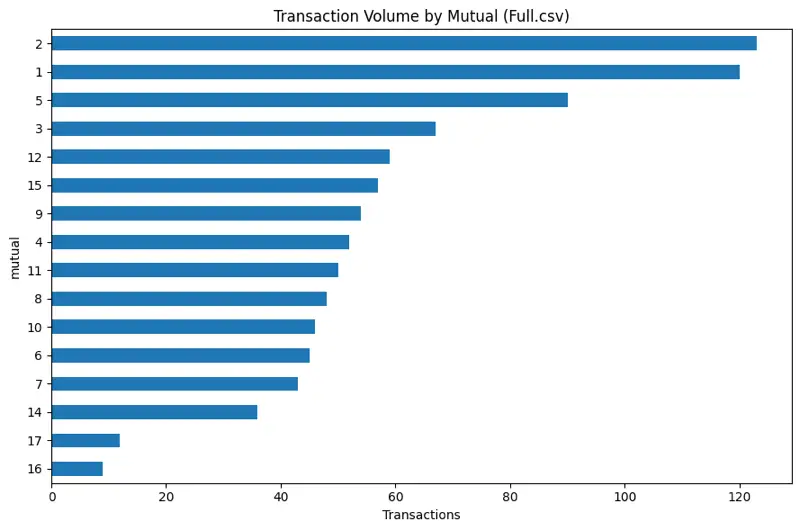
When you look at sheer transaction volume, several Mutuals clearly carry the weight of market activity.
Mutuals 1 and 2 lead the community in total transactions, followed closely by Mutuals 5, 3, and 12. These areas form the liquidity core of Leisure World — the places where buyers and sellers most frequently meet.
High volume does not automatically mean higher prices, but it does signal:
Strong buyer familiarity
Consistent demand
Easier entry and exit for both buyers and sellers
This is where the market breathes most easily.

Pricing: Why Some Mutuals Consistently Sell Higher
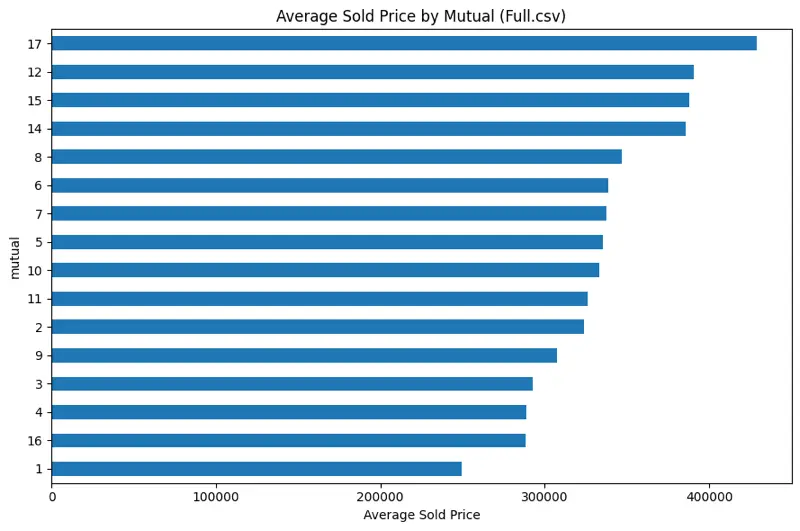
Average sale prices tell a very clear story.
At the top of the pricing spectrum sit Mutuals 17, 12, 15, and 14, all of which share one defining characteristic:
a dominant two-bedroom inventory profile.
The data reinforces a structural truth about Leisure World:
Two-bedroom Mutuals set the pricing ceiling.
This has nothing to do with marketing hype and everything to do with buyer math. Two bedrooms offer flexibility — guests, hobbies, caregivers, resale insurance — and buyers are willing to pay for that optionality.
By contrast, Mutuals with a heavy concentration of one-bedroom units tend to cluster at lower average price points, regardless of condition.
That isn’t judgment. It’s demand structure.

Price per Square Foot: The Quiet Indicator Most People Miss
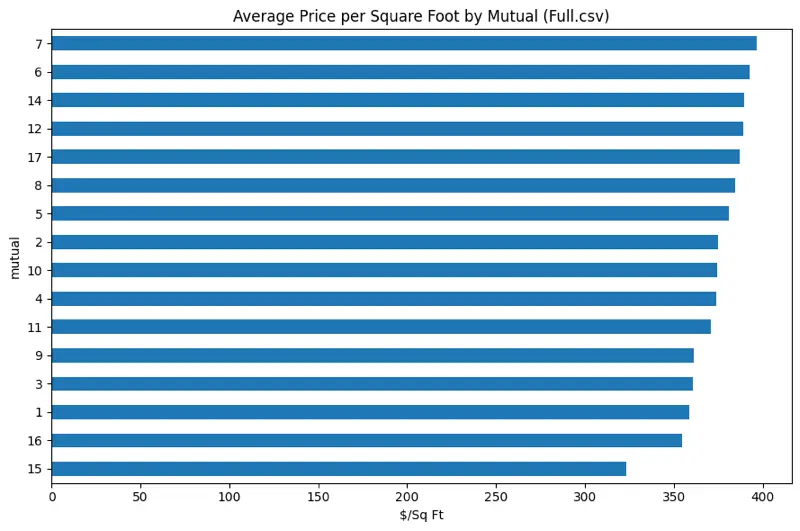
One of the most revealing metrics in the dataset is price per square foot.
This measure strips away emotion and focuses on how buyers value utility.
Several Mutuals with mid-range prices perform extremely well on a per-square-foot basis, signaling:
Strong renovation influence
Efficient layouts
Buyer willingness to pay for how a home lives, not just how big it is
This explains a phenomenon many sellers experience but don’t always understand:
two units of similar size, in the same Mutual, can sell tens of thousands of dollars apart.
In today’s Leisure World market, quality and execution increasingly rival location.

The One-Bedroom Reality (Data, Not Opinion)
One-bedroom units play an important role in Leisure World. They often:
Serve as entry points
Attract cash buyers
Move quickly when priced correctly
But the data is unambiguous:
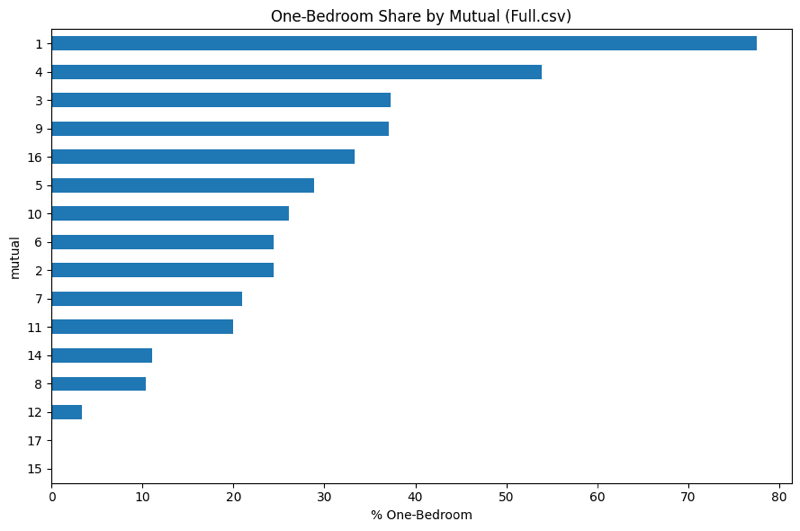
A higher one-bedroom concentration creates a lower pricing ceiling.
Mutuals with predominantly one-bedroom inventory consistently show lower average sale prices than those dominated by two-bedroom layouts. That does not mean they are less desirable — it means they are strategically different.
For sellers, this makes pricing and preparation more critical.
For buyers, it creates opportunity — if you understand the tradeoff.

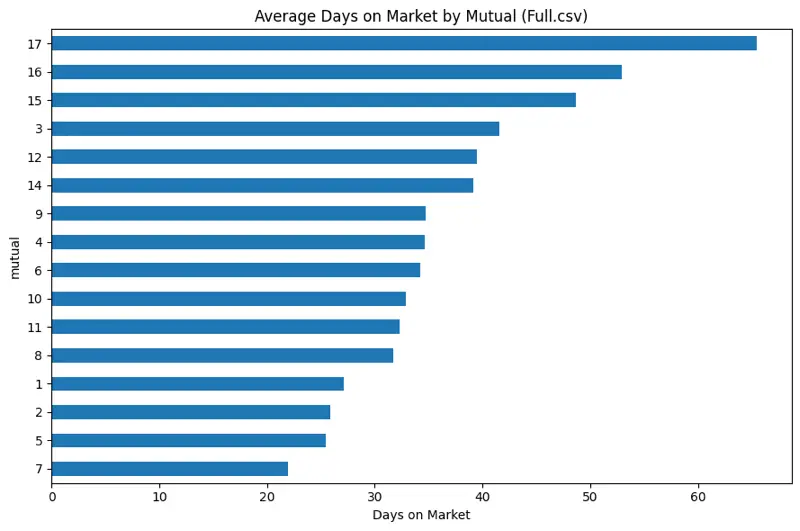
Days on Market: Speed Isn’t the Same as Strength
Another common misconception the data clears up is the meaning of Days on Market.
Some Mutuals sell faster. Others take longer.
But speed alone does not equal market strength.
Higher-priced Mutuals often show longer average marketing times because:
Buyers are more selective
Pricing bands are narrower
Decisions involve more scrutiny
Meanwhile, value-oriented Mutuals reward sharp pricing and presentation with faster escrows.
The takeaway is simple:
Days on Market tells you which strategy you’re playing — not whether the market is “good” or “bad.”

What This Means If You’re Selling
If you’re thinking about selling in Leisure World, the data suggests three things clearly:
Your Mutual sets the ceiling
Strategy determines whether you reach it.
Renovation should be intentional, not emotional
The market rewards targeted improvements, not over-spending.
Pricing must reflect buyer psychology, not neighbor anecdotes
The data always wins.
What This Means If You’re Buying
For buyers, the same data points to opportunity:
Value often lives where expectations lag reality
One-bedroom and slower Mutuals can be strategic entry points
Understanding Mutual-level behavior beats “waiting for the market to change”
Final Thought: Leisure World Rewards Understanding
Leisure World does not reward guesswork.
It rewards context, preparation, and perspective.
When you understand how your Mutual behaves — how buyers think, how pricing forms, and where your unit fits in the larger data picture — the outcome stops being luck and starts being strategy.
If you’d like help interpreting what this data means for your specific unit, that’s exactly the kind of conversation we enjoy having.
—
Mark & Judy Hughes
Leisure Life Real Estate
Leisure World Seal Beach
818-480-2864